
It Takes Two: Rethinking Speech with Sarah Oudet
Jun 19, 2025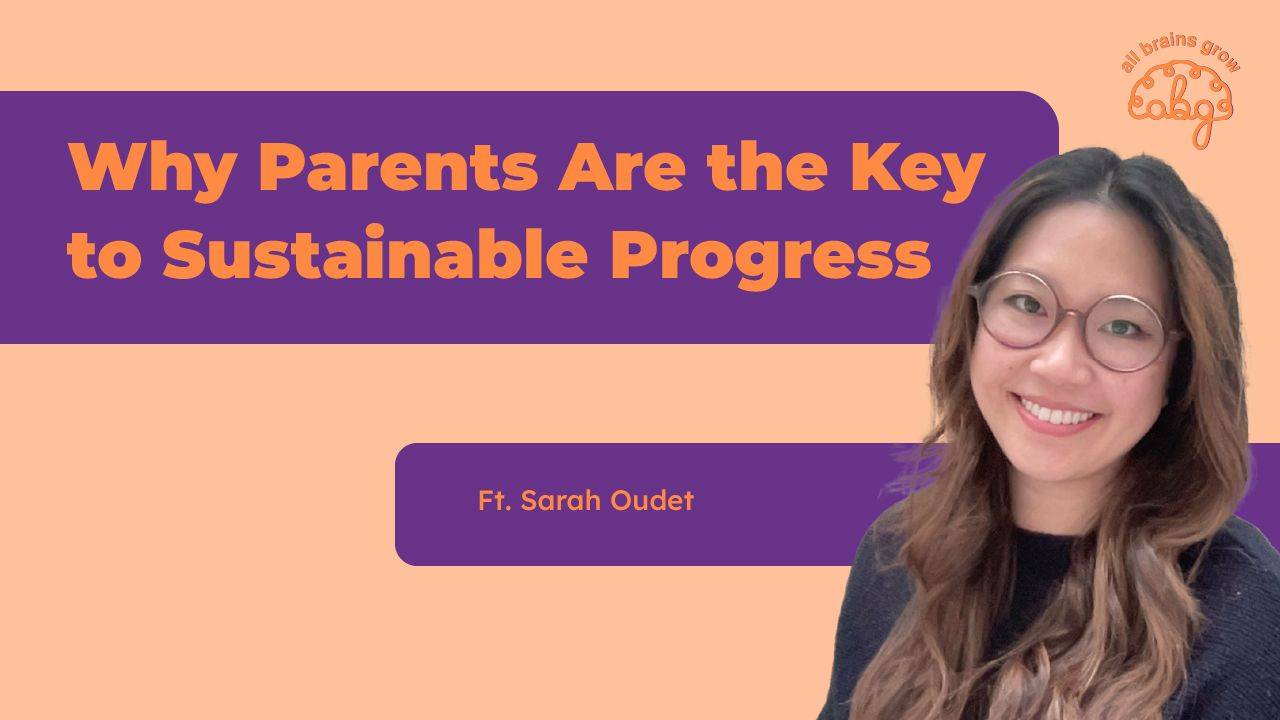
When my child's speech therapist first arrived for a session, I expected her to work directly with my child. I thought my role was to watch, learn, and maybe take a few notes. But I’ve learned that the most powerful approach is different. What if the real focus was on coaching me, the parent?
This parent-led approach—where I became the primary agent of change—wasn't just an alternative; for our family, it became the most sustainable and impactful path to growth.
I recently had a heartfelt conversation with Sarah Oudet, a speech therapist with over 12 years of international experience, and she put words to everything I’ve lived. She explained why empowering parents isn’t just helpful—it’s essential. And her perspective is uniquely powerful, shaped not only by her clinical expertise but by her personal journey as a mother of an autistic son.
Why This Approach Worked for Us
Traditional therapy often places the specialist at the center. But my child doesn’t live in a therapy room—they live at home, at school, and in our community. Sarah helped me see that parent-led therapy, like the Hanen Program, shifts this dynamic entirely: the therapist becomes a coach, and I become the expert in my child’s daily life.
As Sarah told me, “If we can empower and upskill parents with therapeutic strategies, the child benefits all across the week, in all their settings.” This was the key for us. It addressed the biggest challenge we faced: generalization. Skills learned in a clinical setting didn’t always translate to our real life. But when I learned how to foster communication during everyday moments—during meals, play, and errands—the learning became woven into the very fabric of our world.
It’s Not About “Becoming the Therapist”
I’ll be honest, I initially worried that this meant I had to “become the therapist”—adding another overwhelming role to my load. But Sarah reframed this for me. The goal wasn’t to turn me into a clinician; it was to help me use strategies that aligned with our values and our chaotic, beautiful life.
For example, one core strategy she taught me was “following the child’s lead.” This didn’t mean permissive parenting; it meant observing what my child was interested in and building communication opportunities from there. Another key technique was balancing my questions with comments. Instead of asking, “What’s that animal?” I learned to say, “I see a big elephant.” This simple shift reduced the pressure and opened up a space for my child to respond naturally.
These strategies weren’t about adding more tasks to my day. They were about changing the quality of our interaction in the moments we were already sharing.
The Power of Looking at Myself
One of the most powerful, and admittedly vulnerable, tools Sarah encouraged was self-observation. She had me record myself interacting with my child. It felt strange at first, but it offered undeniable feedback. I saw my own patterns—how often I directed the play or rushed to fill the silences—patterns I hadn't realized were unintentionally limiting my child’s communication.
This wasn’t about judgment; it was about awareness. As Sarah told me, “We’re all trying to grow. When you know better, you can do better.”
When Therapy Meets My Parenting Values
A common concern for me was where therapy ended and parenting began. Sarah emphasized that therapeutic strategies should align with my family’s values, not override them. In true evidence-based practice, clinical expertise and research are balanced with what the family prioritizes.
For instance, when “following the child’s lead” conflicted with my need to set a firm boundary—like a safety rule at the park—we adapted the strategy. The goal was always collaboration, not blind compliance.
The Journey to Diagnosis: From Stigma to Support
Hearing Sarah speak about her personal experience seeking an autism diagnosis for her son resonated deeply. She described how stigma affects families, and how well-meaning professionals and relatives often dismissed her concerns with comments like, “He makes eye contact,” or “He can talk.” She called this “toxic positivity”—the urge to reassure parents that “everything is fine”—which can actually erase a child’s real struggles.
For her, and for me, diagnosis wasn’t about labeling our children; it was about understanding them. As Sarah said, “He was already being labeled—as difficult, inattentive, or lazy. I wanted the correct label, one that would lead to support, not shame.”
Choosing Transparency as Our Advocacy
Being open about my child’s diagnosis has been daunting at times, especially in a world where neurodiversity isn’t always understood. Yet, Sarah helped me see transparency as a form of advocacy. When teachers or other parents understand my child’s needs, they can respond with empathy rather than frustration.
She was honest that this doesn’t always work perfectly—disclosure can sometimes be “weaponized.” But I’ve chosen, like her, to lean toward openness, hoping to build bridges through conversation.
I Am the Constant
In these early years, I spend more time with my child than anyone else. That makes me the most consistent influence in their development. While specialists come and go, I remain.
I’ll never forget what Sarah told me at the end of our sessions years ago: “You’re the expert.” That wasn’t just a farewell—it was an affirmation. Parent-led therapy didn’t leave me to figure it out alone. It equipped me with confidence, strategies, and the enduring reminder that I, more than anyone, hold the power to shape my child’s journey.
If you’re considering therapy for your child, remember what I learned: the most sustainable change often begins with you. Not as a replacement for clinical support, but as its most essential partner.
Hear the full story on the podcast.